Good seeing all at class. Loved the creativity of your ideas for the scarf and the sad little trophy; I never expected to hear the phrase “the trophy industrial complex”. So much potential: millennial expectations and merchandising realities and the psychology of external validation.
Likewise, some gold in those 300-word essays. You recognized the elements of a story – conflict, character, emotion – even if the execution didn’t always come together. That’s OK. As we go it will become more natural.
Assignment:
Next week we’ll be going over Swift/Costello and wrapping up the idea discussion. So: By Monday at 5 PM, please send me a list of at least but not limited to three potential ideas – or the germs of ideas. Include why they’re interesting (to you and to readers). Then bring a printout to class. We’ll use part of the class to test ideas. Don’t worry, these aren’t final. Oftentimes, the idea is the most crucial part of any story. Best not to rush into it.
Advice/Details: Think WTF? Have fun with it. Ask your friends for thoughts. And, at this point, don’t limit yourself. Bring six if you want. Or eight. Often, writers will send in a list of ten early ideas and an editor might choose a handful to explore. It can be a two-sentence description. For example: “Spending 24 hours with a former high-level DI athlete who’s now homeless”. OR: “The human impact of the Cal stadium debacle, as told through the eyes of [blank]”. OR: “The untold story of the greatest unicycle juggler of all time”.
One note: It needs to have the potential to be a story, which means characters, an arc, scenes, conflict. It sounds corny but a good way to test out whether that is the case is to try to include the actual word in your pitch, with a modifying adjective. Think of a book blurb or movie tagline. “The haunting story of [blank] who [blank]”. OR: “The hilarious story of [blank] who [blank], leading to [blank]”
Guest
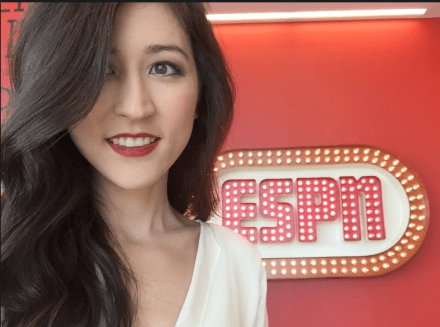
Second, please prepare for our first remote guest, Mina Kimes. Mina graduated from Yale and began her career covering business. In 2012 she wrote this award-winning investigative feature for Fortune, aptly subtitled “A medical horror story”. She headed to Bloomberg News then to ESPN: The Magazine, where she’s now a senior writer, though that term does her a disservice. Mina not only writes long, thoughtful features but also appears frequently on camera, hosts a podcast, produces joint video/text stories, and is a skilled defeater of trolls on the internet. (To see a long cut of one of her E:60 video features, click here). Mina will be able to provide valuable perspective on all manner of topics, from craft to access to ideas to the use of the first person. You’ll find two of her stories in the Readings section; one is on esports and the other on a baseball excursion to Korea, where her mother is from. Please familiarize yourself with her work and prepare questions.
Finally, logistical items:
- The syllabus timeline is now updated, based on our discussion of the most workable deadlines. The first will be February 13 (Week 5), when your final, reported story pitches are due
- By this Thursday all of you should have received either written or verbal feedback on your first two assignments. If you have further questions, shoot me an email or come in next Tuesday during office hours.
- Following up on our class discussion. Here is Kathryn Schulz on the Cascadia fault
- On ideas and stories: If you haven’t read it, this recent NYTimes story on heroin and fentanyl abuse is devastating. Here is a short explanation of how the writer, Katharine Q. Seelye, got the story. Essentially, she started with a broad topic, then reached out to someone who could “put a face on a human crisis”, knowing that the narrative – the story – would allow us to connect.
 Storytelling Through Sports