Good seeing everyone on Tuesday. I love the mix of perspectives, backgrounds, and skillsets in the class, as well as the collaborative atmosphere. I’ve got a great feeling about this semester.
Nice work on deconstructing Roy’s visit. I was impressed with the range and depth of your observations. Being able to notice, interpret, extrapolate, empathize, follow a thread, and then relate a tale: that’s the bedrock of what we’ll be doing. As we go, look for ways to elevate your work until it hits on something universal. As Jack Hart put it (and you will get sick of me saying): “Stories wring meaning from life.”
A few housekeeping items:
- if you haven’t sent me your personal essay, please do so. Knowing your sports background, and getting a feel for your writing, will allow me to be of the most value going forward
- Reiterating from today: We’re all in this together and everyone adds to the value of this class. So please try to be on time, present, and focused. No phones or laptops in class. Pen and paper note-taking serves the secondary purpose of reinforcing your memory. You’ll be able to check texts/emails/etc during the break or, if it’s urgent, let me know ahead of time and duck out. I understand that three hours is a long time.
- Get me your best email address for communication, if I don’t already have it
- Planning: We’ll talk about a schedule for your main project next week
- Enjoyed class? Confused? Hoping for more of X, Y, or Z this semester? Have an amazing idea you want to share? Shoot me an email or come by office hours next week.
For Week Two:
Next week, we’ll build on the first class in two ways. One, we’ll talk in detail about story ideas – how to generate them, test them, and hone them. Second, we’ll look at a couple examples of narratives that combine sports with larger themes. The goal is to give you a sense of the early process, to help you choose and execute your own projects, and to potentially spur ideas.
One of the best ways to do so at this point is by using stories I wrote, for the simple reason that I can walk you through them, step by step. Later in the semester, we’ll talk about gaining access and trust from big-name athletes, but for now, we’ll focus on stories where the barrier to entry isn’t too high.
So for next week, please read the following stories. One is about a former marginal NBA player who’s hit bottom. The other is about a young woman on the Cal rowing team.
What Happened to Robert Swift?, Sports Illustrated
The Courage of Jill Costello, Sports Illustrated
Brady Dennis Assignment
Finally, as we went over in class, please produce your own 300-word story and send it to me, via email, by Monday at 5 PM.
A formatting note: Please put your name on both the top of your paper and on your file. For example: name your file “Chris 300 word essay”. Then, at the top of your Word doc, write your name, assignment, and date.
Details:
- Here is the Dennis story we read
- Here is the Neiman interview about how he did it
- Here is a handy sheet of other 300 word examples for inspiration
- Basics: Interview someone in the sports realm, preferably in person, and draw out a story about his or her life. Use details, observation, scene, etc. All the tools of storytelling
- The goal: Give us an arc – either of one moment in someone’s life or her whole life or part of it. Make us feel something.
- It must be at least tangentially related to sports. So: a 90-year-old who bikes up to Grizzly Peak every Saturday. Or: the guy who washes the uniforms for the Cal basketball team. Or: The top-ranked horseshoes player in Berkeley (if such a thing exists). Look for motivation, backstory, passion.
- Most important: have fun with it. Let yourself be creative. Cut out your inner editor. Take a chance. As long as you put in effort, the exercise will be a success.
- Of note: This is the kind of exercise that can sometimes lead to other story ideas, or even a publishable story – maybe even your project. Be open to possibilities
- Looking for more inspiration, or for a sense of how this applies in the real world? It’s not 300 words, but this recent, heart-rending (non-sports) narrative about the Vegas shootings is an example of a writer, Wesley Lowery, who used small details to flesh out characters in the service of a larger point. His storytelling raises this above other news accounts.
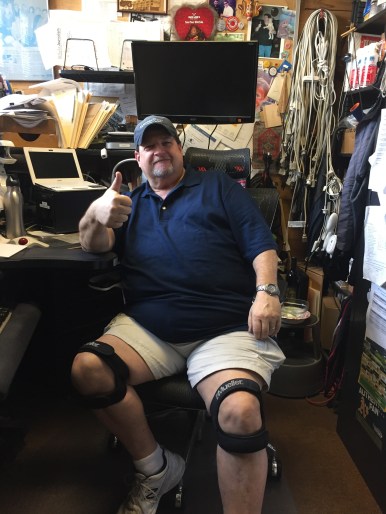
Finally, thanks to Roy. He’s a good sport.
 Storytelling Through Sports